|
|
Legacy Walk
|
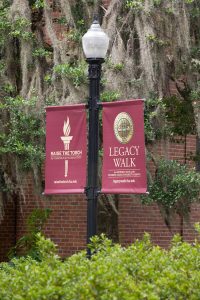
Florida State University has been paving the way since 1851. In October 2004, the university unveiled the first of four phases of Legacy Walk, a historical tour of campus that focuses on its architecture, sculpture and green spaces. The first segment of the Walk, the Eppes Phase, is named for the founder of the University, Francis Eppes. Encompassing the easternmost portion of campus, the Walk begins at the Eppes statue located near the entrance to the Westcott Building. The path is embedded with symbols and lined with bricks and banners guiding visitors past many of the oldest and most historic buildings on campus before terminating at Dodd Hall. Raised brick podia containing maps and important information about people and events are located at intervals along the walk.
The second phase, the Student Legacy Walk, begins at the Landis Green Legacy Fountain Sculptures. As the name suggests, the Student Legacy Walk passes through the core of student activity, highlighting student leaders of the past and serving as a living legacy to current and future students. Lined with banners depicting campus life, the Student Legacy Walk guides visitors from Landis Green north toward the Bellamy Building, around to newly renovated grounds behind the Crenshaw Building and Moore Auditorium, and circles the Integration Statue before wrapping around the Student Services Building and ending back at Landis.
For more information on the FSU Legacy Walk, contact the Office of University Relations at 850.644.1000.
|
|
The Eppes Walk
The Eppes Walk, the first of four planned phases of The Florida State University Legacy Walk begins at the statue of Francis Eppes located near the front of the Westcott Building.
Sights along the walk:
(1) Francis Eppes
(2) Mina Jo Powell Green
(3) Longmire Building, Opperman Music Hall, Housewright Music Building
(4) Sandels Green, Sandels Building, Jennie Murphree Hall, Cawthon Hall
(5) Strozier Library, Landis Green, Landis Hall, William Johnston Building
(6) Gilchrist Hall, Gilchrist Gateway
(7) Broward Hall, Bryan Hall
(8) Dodd Hall, Werkmeister Window
(9) Williams Building, Diffenbaugh Building, Westcott Building, Westcott Plaza
|

Francis Eppes Statue
|
 |
(1) Francis Eppes
Francis Eppes VII moved to Tallahassee from Virginia in 1829 and quickly took an active role in local affairs. After serving as a Justice of the Peace and then Intendant (Mayor) of Tallahassee, Eppes shifted his focus to educational issues. The General Assembly of the Florida Legislature enacted a bill on January 24, 1851, that established two seminaries of learning in the State of Florida, with locations to be determined. When it was announced that the two cities offering the best facilities would each be awarded an institution, Eppes set out to ensure that Tallahassee would be one of them. In 1857, the Florida Institute, previously established in 1854 as a school for boys, began operating as the Seminary West of the Suwannee. It was located on the site of the present Westcott Fountain and Plaza. Eppes served on the Seminary's Board of Trustees for 11 years, the last eight as President. A life-size bronze statue of Francis Eppes was created by Tallahassee artist Edward Jonas and installed in 2003.
|
 |

Memorial Fountain and Pond
|
(2) Mina Jo Powell Green
From the Eppes statue, walk to the north side of Westcott where the first map podium is located. Continue along the north side of the building, cross the street and enter Mina Jo Powell Green. A fountain and a fishpond mark the green where the sidewalks intersect.
In 1990, University President Bernard F. Sliger officially named this Green in honor of Mina Jo Powell, a distinguished alumna and university supporter. Student gatherings have been held on the Green since the 1930s, and some of the camellia trees that line the sidewalks are older than the surrounding buildings.
The Memorial Fountain and Pond were commissioned by the Student Government Association (SGA) to honor all students who died while attending FSU. The memorial incorporates black Virginia slate with a 50-ton black granite boulder that was quarried in Africa. It is inscribed with a quotation selected by SGA. The fountain, pond and the Gothic benches were built in the University's Master Craftsman Studio.
|
| (3) Longmire Building, Opperman Music Hall, Housewright Music Building
Continue on the sidewalk toward the Longmire Building. On the right is the Mart Hill Garden, the School of Music amphitheatre and Opperman Music Hall. Visitors may enter Longmire or descend the stairs on the left to the sidewalk and pass in front of the Longmire Building.
Longmire Building was constructed in 1938 and named in honor of Rowena Longmire, founder of the Florida State College for Women (FSCW) Alumni Association. Although renovated in 1969, the building retains its architectural integrity. Originally constructed for use by the Alumni Association, Longmire has, through the years, housed a soda shop, a music library and a law library. The lobby and first floor offices still retain their original oak paneling and the Beth Moor and Alumni lounges have hand-painted plaster ceilings and Gothic décor.
As director of the School of Music from 19111943, Ella Scoble Opperman was responsible for the construction of Opperman Music Hall. Kuersteiner Music Building, of which it is a part, was built in 1948 and was considered one of the best music facilities in the United States at the time of its construction.
Housewright Music Building, constructed in 1979, is a contemporary three-story structure that is connected to the Kuersteiner Music Building by an open-air walkway. The building was named for Wiley Housewright, a former Dean of the School of Music.
|
 |

Cawthon Hall
|
(4) Sandels Green, Sandels Building, Jennie Murphree Hall, Cawthon Hall
Cross Ivy Way where the Legacy Walk symbol appears in the sidewalk and enter Sandels Green. The Green is flanked by the Sandels Building on the north and Jennie Murphree Hall on the south. Cawthon Hall can be seen ahead on the left. At the center of the Green is a paved area and low wall where visitors may rest in the shade.
Jennie Murphree Hall was named in honor of the wife of the first president of Florida State College for Women, Dr. Albert A. Murphree. The building was constructed in 1922, and in 1924, the west wing was extended to accommodate a growing student population. In 1992, Jennie Murphree Hall underwent a major exterior restoration and interior remodeling. It has always served as student housing.
The Sandels Building, which houses the College of Human Sciences, was constructed in 1955 and named for Margaret R. Sandels, Dean of the School of Home Economics from 19221958.
Dotting Sandels Green are a number of outdoor sculptures that represent the work of internationally-renowned artists, including Lynn Chadwick, Ju Ming, and Allan Houser. The sculptures are part of a private collection that is on loan to FSU.
Cawthon Hall was named for Sarah L. "Tillie" Cawthon, the first Dean of the College Home, now Student Affairs. Built in 1946, it serves as a residence hall that houses the Education Learning Community and the Music Living-Learning Center.
|

Montgomery Hall
|
 |
(5) Strozier Library, Landis Green, Landis Hall, William Johnston Building
Follow the sidewalk marked with brick, descend the steps and cross Dogwood Way at the Legacy Walk marker. Strozier Library is on the west side of the street, as is the second podium. Here, the map denotes the second half of the Eppes Walk. Continue south along the sidewalk bordering Landis Green.
Strozier Library was built in 1956 and still serves as the main campus library. It is named for Robert Manning Strozier, who was FSU's President from 19571960. In 1967, a seven-story addition brought the building to its present configuration. It is undergoing extensive interior renovation.
As early as 1932, Landis Green provided students with outdoor recreational space. This rectangular grassy area, bounded by Landis Hall, Strozier Library, the William Johnston and Montgomery buildings, comprises one of the most distinctive quadrangles on historic east campus. Landis Green and Landis Hall (which terminates it on the north) are named for Cary D. Landis, a former Florida Attorney General and proponent of higher education. On the north end of the Green is a marble tablet honoring Omicron Delta Kappa, one of the University's most prestigious honor societies. At the center of the Green is a fountain commemorating the University's transition from Florida State College for Women to Florida State University. The six bronze sculptures in the fountain are the work of Tallahassee artist Edward Jonas.
At the time of its construction in 1939, Landis Hall was the largest dormitory on campus. It is undergoing a complete renovation.
William Johnston, the Gothic Revival Building on the east side of Landis Green, is decorated with symbols depicting its original function as a dining hall. A complete renovation of the building is under way including the restoration of the dining hall's original vaulted ceiling.
|
 |

Gilchrist Hall
|
(6) Gilchrist Hall, Gilchrist Gateway
Follow the brick-marked sidewalk under the overpass connecting Landis and Gilchrist Halls. Walk to the corner and turn left, crossing Dogwood Way. Follow the sidewalk on the north side of the street, passing in front of Gilchrist and Broward Halls.
Gilchrist Hall was named for Governor Albert W. Gilchrist. The east wing was constructed in 1926, and the south and west wings were added in 1928. The three-story structure has been continuously used as a residence hall. Just to the south of Gilchrist Hall is the Gilchrist Gateway, which opens onto Jefferson Street. The Collegiate Gothic gateway was designed and built in 1933 and it serves as the south entrance to the campus. The gateway was the gift of the Classes of 1933 and 1935.
|

Bryan Hall
|
 |
(7) Broward Hall, Bryan Hall
Pass Broward Hall on the left and stop at the corner of Bryan Hall. Pause to look to your left down the row of dormitories and banners that include Bryan Hall, Reynolds Hall and Jennie Murphree Hall.
Broward Hall, named for Governor Napoleon Bonaparte Broward, was the third brick dormitory built on the campus of the Florida State College for Women. It was constructed in 1917 in response to a pressing need for more on-campus living space.
Bryan Hall is the oldest extant campus building, having been constructed in 1907 and named for William James Bryan, a United States Senator from Jacksonville.
|
 |

Dodd Hall
"The half of knowledge is to know
where to find knowledge"
|
(8) Dodd Hall, Werkmeister Window
Proceed to the corner of University Way and Ivy Way and note the Dodd Hall banner. Visitors are encouraged to cross the street and enter Dodd Hall.
Dodd Hall is the most elaborate example of Collegiate Gothic architecture on the campus. The smaller west wing was built in 1925. The larger east and south wings were constructed between 1928 and 1929, bringing the building to its current configuration. Over the main entrance, rendered in gold leaf, are the words, "The half of knowledge is to know where to find knowledge." Home to the library until 1956 when Strozier Library opened, Dodd Hall has since housed the College of Arts and Sciences, the Philosophy Department and WFSU-TV. In 1961, the building was renamed in honor of William George Dodd, a former English professor and Dean of the College of Arts and Sciences from 19101944. Dodd Hall was completely renovated in 1991 and retains both interior and exterior architectural integrity. Even the construction of the new Dodd Hall Auditorium completed in 1993 did not detract from the building's architectural presence. In the lobby of Dodd Hall, note the large oil painting on the east wall. Commissioned by the Class of 1949 and painted by renowned artist and FSU alumna Artemis Housewright, The University, Sunrise to Sunset depicts University history and local flora and fauna.
Werkmeister Humanities Reading Room is located in the original west wing of Dodd Hall. At the west end of the reading room is a memorial stained glass window designed by Professor Emeritus Ivan Johnson and created by FSU Alumni Bob and Jo Ann Bischoff. This spectacular window was unveiled and dedicated on October 31, 1997, as the first phase of a total restoration planned for the room. The Werkmeister Window is 22 feet tall and ten feet wide and consists of more than 10,000 pieces of glass.
|

Westcott Plaza
|
 |
(9) Williams Building, Diffenbaugh Building, Westcott Building, Westcott Plaza
Continue on University Way crossing Ivy Way. Proceed up the west side of the Westcott Building, round the corner and walk into Westcott Plaza. From Westcott Plaza, visitors can see the Williams and Diffenbaugh Buildings on the south and the Eppes Building on the north.
Williams Building, originally called the History Building, was constructed in 1927 and named in 1963 for Arthur Williams who was the first Chairman of the History Department. Today, the Williams Building houses the Augusta Conradi Theatre and classrooms.
The original Diffenbaugh Building was built in 1922 and known as Science Hall. It was the third academic facility built on campus. It has since been enlarged and modernized, although the original Gothic entrance was incorporated into the main façade.
Built in 1910, Westcott Administration Building is the architectural centerpiece of Florida State University campus. It can be seen clearly from the center of town, just one mile to the east. The view down College Avenue towards Westcott gives the university a strong presence in the community. This Collegiate Gothic building was known originally as the Administration Building. In 1936, it was renamed James D. Westcott Memorial Building in honor of the Florida jurist who bequeathed his entire estate to the Florida State College in 1887. In April of 1969, most of the interior was destroyed by fire. The renovation of the inside was completed in 1973; the exterior retains its original architectural integrity.
The fountain on Westcott Plaza was a gift of the classes of 1915 and 1917; the original fountain graced the main entrance to the campus for over 70 years. It was renovated in 1982 in remembrance of Professor Anna Forbes Liddell, 19591960 Robert O. Lawton Distinguished Professor of Philosophy. In the summer of 1988, when the supporting structure began to fail, the historic fountain was replaced with an exact replica.
Westcott Gate serves as the main entrance to the University. It was built in 1916 and given to the University by the classes of 1916 and 1918. Until 1947, the iron arch between the main piers that now reads "Florida State University" read "Florida State College for Women." More than any other structures on campus, Westcott Building, gate and fountain have come to symbolize Florida State University.
The commemorative brick plaza that surrounds the fountain originated as a project of the classes of 1996 and 1997. It was constructed in 1998 with donations from alumni, students, faculty, staff and friends of the University.
Eppes Hall, constructed in 1918, is situated on the north side of Westcott Plaza.
|
|
 |